
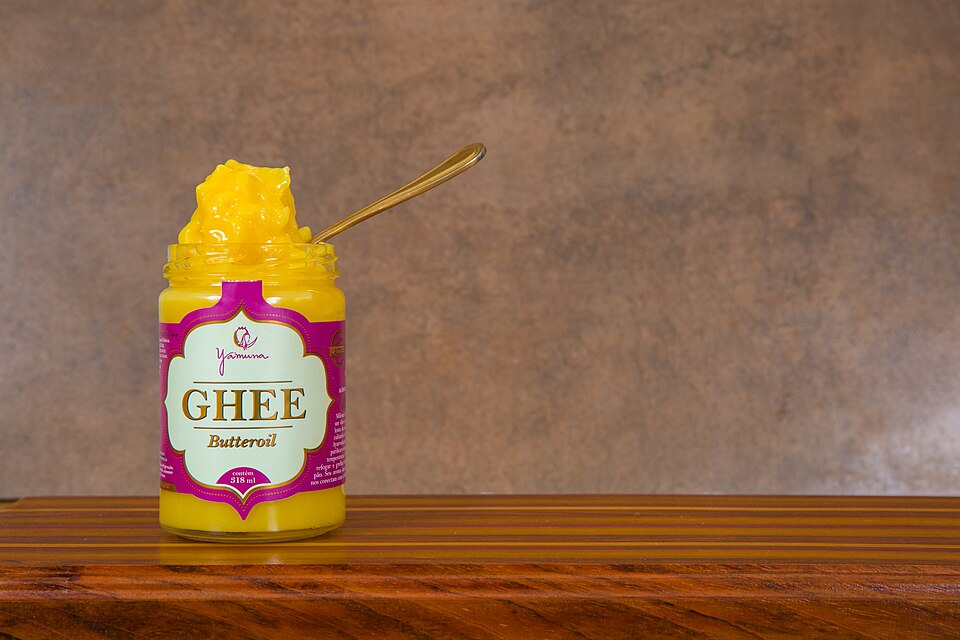
The claim: desi ghee is either a sacred superfood that "lubricates joints, sharpens memory and boosts immunity" — or a heart-clogging saturated fat bomb that belongs in the past. In South Asian homes, this debate gets genuinely emotional: dadi swears by it, the cardiologist warns against it, and wellness influencers now sell "A2 bilona ghee" at luxury prices. Both camps claim science is on their side. So what does the research actually say about this golden staple?
What ghee actually is
Ghee is butter taken one step further. Butter is simmered until its water evaporates and its milk solids (proteins and sugars) brown and settle out; the clear golden fat is strained off. What's left is almost pure butterfat — about 99% fat, with roughly 60–65% of it saturated, most of the rest monounsaturated, and a small amount of polyunsaturated fat.
Removing the milk solids does three useful things: it gives ghee a much higher smoke point than butter (around 250°C vs butter's ~175°C), it removes nearly all the lactose and casein (so most lactose-intolerant people tolerate ghee fine), and it gives ghee its distinctive nutty aroma plus a long shelf life without refrigeration. Traditional bilona ghee — made by churning curd into butter first, then clarifying — is the slow, artisanal version; most commercial ghee is made directly from cream. Chemically, they're very similar.
Per tablespoon (about 14g), ghee delivers roughly 120 calories and 14g of fat — identical to any other pure fat, since all fats carry 9 calories per gram. There is no "light" ghee; fat is fat.
Why the debate is so heated
Ghee sits at the collision point of three powerful forces. First, culture and Ayurveda: ghee has been revered in South Asia for millennia — used in cooking, rituals and traditional medicine, where it's credited with improving digestion, memory and vitality. Dismissing it outright feels like dismissing heritage itself. Second, modern cardiology: South Asia has among the world's highest rates of heart disease, striking at younger ages than in the West — and saturated fat reliably raises LDL cholesterol, a major heart-risk factor. Third, wellness marketing: the global "ancestral foods" trend has rebranded ghee as a superfood, and premium brands now charge several times the regular price for "A2" or "bilona" labels with health claims the evidence doesn't support.
All three forces contain some truth. The honest answer isn't on either extreme — it's in the dose, the context and the comparison.
The honest case FOR ghee
Ghee does have genuine strengths. Let's give them their due:
- Superb for high-heat desi cooking. This is ghee's strongest, least debatable advantage. Its high smoke point (~250°C) means it stays stable during tadka, deep-frying and high-heat paratha-making, breaking down into harmful compounds far more slowly than butter or extra-virgin olive oil. For the way South Asian food is actually cooked, ghee is genuinely one of the best-performing fats.
- Butyric acid for gut health. Ghee contains small amounts of butyrate, a short-chain fatty acid that nourishes the cells lining the colon. Butyrate is genuinely important for gut health — though your gut bacteria also make it themselves when you eat fibre, which is a far bigger source.
- CLA (conjugated linoleic acid). Ghee from grass-fed cows contains modest amounts of CLA, which has shown mildly beneficial effects on body composition and inflammation in some studies. The amounts in a normal serving are small, and most CLA research uses concentrated supplements, not food doses.
- Fat-soluble vitamins. Ghee carries vitamins A, D, E and K. This is partly why haldi-doodh (turmeric milk) "works better" with a little fat — curcumin and several vitamins need fat for absorption. But a teaspoon of any fat does this job.
- Lactose-free and casein-free. The clarifying process removes the milk solids, so ghee is generally fine for lactose-intolerant people and many with milk-protein sensitivities.
- Flavour. Let's not pretend this doesn't matter. Ghee's nutty aroma transforms dal, khichdi and parathas in a way no neutral oil can. Food you enjoy is food you'll actually eat — and traditional dishes taste like themselves because of ghee.
The honest case AGAINST ghee
Now the other side — and it's substantial:
- Saturated fat raises LDL cholesterol. This is one of the most replicated findings in all of nutrition science: replacing unsaturated fats with saturated fat reliably raises LDL ("bad") cholesterol, which is a causal factor in heart disease. At 60–65% saturated fat, ghee is firmly in the "raises LDL" category. This isn't disputed by serious researchers — it's the starting point of the debate, not one side of it.
- South Asia's heart-disease burden. South Asians develop heart disease earlier and at lower body weights than Western populations, with a tendency toward dangerous abdominal fat and insulin resistance. In a population already at elevated risk, generous saturated-fat intake is a plausible contributor — not the sole cause (refined carbs, inactivity and smoking matter too), but part of the picture.
- The dose problem. Traditional ghee use was a teaspoon or two — a flavouring, a finishing touch. The modern habit in many households is free-pouring: tablespoons per meal, ghee-roasted everything. Benefits claimed at traditional doses do not scale to cupfuls. Every "pro-ghee" study cited by marketers used modest amounts; none bless unlimited pouring.
- Calories are calories. At 120 calories per tablespoon, ghee is energy-dense. Excess ghee absolutely contributes to weight gain, and excess weight is itself a heart and diabetes risk.
- The "superfood" claims are overblown. "Lubricates joints," "boosts memory," "detoxifies" — these are Ayurvedic-traditional claims, not findings of modern clinical trials. Tradition deserves respect, but it isn't evidence. No well-designed human trial shows ghee improving memory or joint health.
Ghee vs butter vs cooking oils — the full comparison
The right question is never "is ghee good or bad?" in isolation — it's "compared to what?" Here's how the common options stack up:
| Fat | Saturated fat | Smoke point | Best for |
|---|---|---|---|
| Desi ghee | ~62% | ~250°C | High-heat desi cooking, flavour |
| Butter | ~63% | ~175°C | Baking, spreading — not high heat |
| Mustard oil | ~12% | ~250°C | High-heat desi cooking, better fat profile |
| Canola / sunflower oil | ~7–10% | ~230°C+ | Everyday frying, neutral taste |
| Extra-virgin olive oil | ~14% | ~190°C | Salads, low-medium heat (not tadka) |
| Coconut oil | ~90% | ~175°C | Flavour in specific dishes — worst fat profile |
| Vanaspati / dalda | High + trans fats | High | Nothing — avoid entirely |
Two takeaways. First, vanaspati/dalda is in a different league of bad: partially hydrogenated oils contain artificial trans fats, which raise LDL and lower HDL — the worst combination. If your household still uses dalda, switching to anything else on this table is an upgrade. Second, for everyday heart health, unsaturated oils (mustard, canola, sunflower, groundnut) have the strongest evidence — while ghee wins on high-heat stability and flavour.
What about "A2" and "bilona" ghee?
Premium brands charge 2–4x for ghee labelled "A2" (from cows producing only A2 beta-casein protein) or "bilona" (the traditional curd-churning method). Let's be clear about what these labels mean: A2 refers to the milk source, not the fat chemistry. Ghee is 99% fat — the protein difference between A1 and A2 milk barely survives into the finished product. There is no strong evidence that A2 ghee is meaningfully healthier than regular ghee. Bilona is a traditional, labour-intensive method that may produce slightly better flavour and aroma — a legitimate artisanal premium, like single-origin coffee — but not a health transformation. Buy them for taste and tradition if you can afford it, not for medical benefits.
How to use ghee right
You don't have to choose between heritage and health. Here's the balanced approach:
- Use ghee where it earns its place: tadka, parathas, dal finishing, high-heat frying — the jobs where its stability and flavour genuinely excel.
- Use unsaturated oils for the rest: everyday sabzi, general frying and salad use. Mustard oil is the traditional South Asian unsaturated option with a high smoke point — a natural partner to ghee.
- Measure, don't pour. Traditional wisdom said a teaspoon or two; modern nutrition agrees. One to two teaspoons a day as part of cooking is reasonable for most people. Tablespoons per meal is where the LDL maths turns against you.
- Count total saturated fat, not just ghee. If your diet already includes full-fat dairy, fatty meats, palm oil snacks and mithai, the ghee is adding to an already-high load. The whole day's fat pattern matters more than any single ingredient.
- Never use vanaspati/dalda. If cost is the concern, refined vegetable oils are cheaper than ghee and far safer than dalda.
- Store it well: ghee keeps for months at room temperature in an airtight jar away from light. Discard if it smells rancid or "off" — oxidised fats are worse than fresh ones.
Who should be careful
- People with high LDL or heart disease: this is the clearest caution group. If your LDL is elevated or you have established heart disease, every tablespoon of saturated fat counts — discuss your cooking fats with your doctor.
- People with type 2 diabetes or metabolic syndrome: South Asians carry elevated risk here, and excess saturated fat worsens insulin resistance. Moderation matters doubly.
- Anyone watching weight: 120 calories per tablespoon adds up fast. Free-poured ghee is one of the easiest ways to overshoot daily calories without noticing.
- People with gallbladder issues: very fatty meals can trigger gallbladder pain in those with gallstones — ghee-heavy meals included.
- Milk-allergy sufferers (rare): ghee is nearly free of milk protein, but trace casein can remain — those with severe milk allergy should verify with their doctor rather than assume safety.
Myth vs fact — quick reference
| The claim | Reality |
|---|---|
| Ghee is a superfood | Myth. Good cooking fat with modest extras — not medicine. |
| Ghee clogs arteries by itself | Oversimplified. Its saturated fat raises LDL; dose and overall diet decide the risk. |
| Ghee is better than oil for high-heat cooking | Fact — high smoke point, very stable. |
| A2/bilona ghee is much healthier | Myth. Taste/tradition premium, not a health upgrade. |
| Vanaspati is a cheap ghee alternative | Dangerous myth. Trans fats — avoid entirely. |
| Traditional small amounts are fine | Fact — a teaspoon or two is very different from free-pouring. |
| Ghee boosts memory and lubricates joints | Unproven. Traditional claims without clinical-trial backing. |
Quick questions
Is ghee better than refined oil?
For high-heat cooking, yes — ghee's high smoke point makes it more stable. For everyday heart health, unsaturated oils (mustard, canola, sunflower) have the stronger evidence. Smart kitchens use both, each where it excels.
Does ghee cause weight gain?
At 9 calories per gram like all fats, excess ghee absolutely adds weight. A tablespoon carries ~120 calories. Portion size is everything — traditional teaspoon servings are a different story from free-pouring.
What about "A2" ghee — worth the premium?
A2 refers to the milk's protein type, not the fat chemistry, and ghee is 99% fat. No strong evidence shows A2 ghee is meaningfully healthier. Pay extra for flavour and artisanal method if you like — not for health claims.
Can lactose-intolerant people eat ghee?
Usually yes. The clarifying process removes nearly all lactose and milk protein, so most lactose-intolerant people tolerate ghee well. Those with severe milk allergy (different from intolerance) should check with a doctor, as trace casein can remain.
Is ghee OK for cholesterol patients?
With caution and medical guidance. Ghee's saturated fat raises LDL, so people with high cholesterol or heart disease should limit it strictly and favour unsaturated oils. Discuss your personal limit with your doctor.
Ghee vs butter — which is healthier?
They're nearly identical nutritionally (both ~62–63% saturated fat). Ghee wins for high-heat cooking because of its higher smoke point and lacks lactose; butter wins for spreading and baking. Neither is a health food.
How much ghee per day is reasonable?
For most healthy adults, one to two teaspoons daily within cooking is reasonable — the traditional amount. Count it within your total saturated-fat intake for the day, and balance it with unsaturated oils.